variant class. More...
#include <variant.hpp>
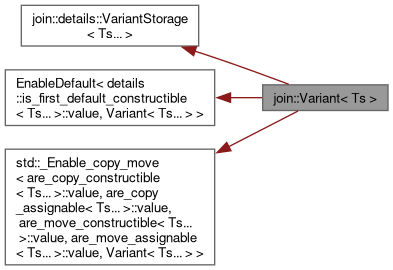
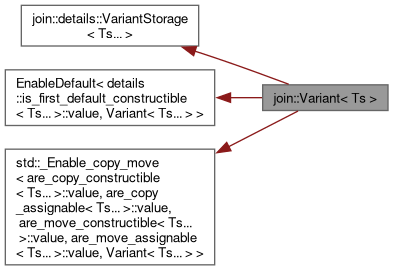
Public Types | |
| using | Base = details::VariantStorage<Ts...> |
| using | DefaultEnabler = EnableDefault<details::is_first_default_constructible<Ts...>::value, Variant<Ts...>> |
Public Member Functions | |
| constexpr | Variant ()=default |
| default constructor. | |
| constexpr | Variant (const Variant &)=default |
| copy constructor. | |
| constexpr | Variant (Variant &&)=default |
| move constructor. | |
| template<typename T , typename Match = match_t<T&&, Ts...>, typename = std::enable_if_t<is_unique<Match, Ts...>::value && std::is_constructible<Match, T&&>::value>> | |
| constexpr | Variant (T &&t) |
| constructs a Variant holding the alternative selected by overload resolution. | |
| template<typename T , typename... Args, typename = std::enable_if_t<is_unique<T, Ts...>::value && std::is_constructible<T, Args&&...>::value>> | |
| constexpr | Variant (in_place_type_t< T >, Args &&... args) |
| constructs a Variant with the specified alternative T. | |
| template<typename T , typename Up , typename... Args, typename = std::enable_if_t<is_unique<T, Ts...>::value && std::is_constructible<T, std::initializer_list<Up>&, Args&&...>::value>> | |
| constexpr | Variant (in_place_type_t< T >, std::initializer_list< Up > il, Args &&... args) |
| constructs a Variant with the specified alternative T. | |
| template<std::size_t I, typename... Args, typename = std::enable_if_t<std::is_constructible<find_element_t<I, Ts...>, Args&&...>::value>> | |
| constexpr | Variant (in_place_index_t< I >, Args &&... args) |
| constructs a variant with the alternative T specified by the index I. | |
| template<std::size_t I, typename Up , typename... Args, typename = std::enable_if_t< std::is_constructible<find_element_t<I, Ts...>, std::initializer_list<Up>&, Args&&...>::value>> | |
| constexpr | Variant (in_place_index_t< I >, std::initializer_list< Up > il, Args &&... args) |
| constructs a variant with the alternative T specified by the index I. | |
| ~Variant ()=default | |
| destroy the Variant instance. | |
| constexpr Variant & | operator= (const Variant &other)=default |
| copy assignment. | |
| constexpr Variant & | operator= (Variant &&other)=default |
| move assignment. | |
| template<typename T , typename Match = match_t<T&&, Ts...>> | |
| constexpr std::enable_if_t< is_unique< Match, Ts... >::value &&std::is_constructible< Match, T && >::value, Variant & > | operator= (T &&t) |
| assign a Variant holding the alternative selected by overload resolution. | |
| template<typename T > | |
| constexpr std::enable_if_t< is_unique< T, Ts... >::value, bool > | is () const |
| check that the member type in use is the same than the one specified. | |
| template<std::size_t I> | |
| constexpr std::enable_if_t< is_index< I, Ts... >::value, bool > | is () const |
| check that the index in use is the same than the one specified. | |
| template<typename T , typename... Args> | |
| constexpr std::enable_if_t< is_unique< T, Ts... >::value &&std::is_constructible< T, Args &&... >::value, T & > | set (Args &&... args) |
| set the variable type of the object identified by type and assign it a value. | |
| template<typename T , typename Up , typename... Args> | |
| constexpr std::enable_if_t< is_unique< T, Ts... >::value &&std::is_constructible< T, std::initializer_list< Up > &, Args &&... >::value, T & > | set (std::initializer_list< Up > il, Args &&... args) |
| set the variable type of the object identified by type and assign it a value. | |
| template<std::size_t I, typename... Args> | |
| constexpr std::enable_if_t< std::is_constructible< find_element_t< I, Ts... >, Args &&... >::value, find_element_t< I, Ts... > & > | set (Args &&... args) |
| set the variable type of the object identified by index and assign it a value. | |
| template<std::size_t I, class Up , class... Args> | |
| constexpr std::enable_if_t< std::is_constructible< find_element_t< I, Ts... >, std::initializer_list< Up > &, Args &&... >::value, find_element_t< I, Ts... > & > | set (std::initializer_list< Up > il, Args &&... args) |
| set the variable type of the object identified by index and assign it a value. | |
| template<typename T > | |
| constexpr std::enable_if_t< is_unique< T, Ts... >::value, T & > | get () |
| get the variable value of the object type identified by type. | |
| template<typename T > | |
| constexpr std::enable_if_t< is_unique< T, Ts... >::value, const T & > | get () const |
| get the variable value of the object type identified by type. | |
| template<std::size_t I> | |
| constexpr std::enable_if_t< is_index< I, Ts... >::value, find_element_t< I, Ts... > & > | get () |
| get the variable value of the object type identified by index. | |
| template<std::size_t I> | |
| constexpr std::enable_if_t< is_index< I, Ts... >::value, const find_element_t< I, Ts... > & > | get () const |
| get the variable value of the object type identified by index. | |
| template<typename T > | |
| constexpr std::enable_if_t< is_unique< T, Ts... >::value, T * > | getIf () |
| get the variable value address of the object type identified by type. | |
| template<typename T > | |
| constexpr std::enable_if_t< is_unique< T, Ts... >::value, const T * > | getIf () const |
| get the variable value address of the object type identified by type. | |
| template<std::size_t I> | |
| constexpr std::enable_if_t< is_index< I, Ts... >::value, find_element_t< I, Ts... > * > | getIf () |
| get the variable value address of the object type identified by index. | |
| template<std::size_t I> | |
| constexpr std::enable_if_t< is_index< I, Ts... >::value, const find_element_t< I, Ts... > * > | getIf () const |
| get the variable value address of the object type identified by index. | |
| constexpr std::size_t | index () const noexcept |
| return the index of the alternative that is currently held by the variant. | |
| void | swap (Variant &other) noexcept |
| swap this variant with another. | |
Protected Member Functions | |
| constexpr bool | equal (const Variant &rhs) const |
| check if equal. | |
| constexpr bool | lower (const Variant &rhs) const |
| check if lower than. | |
Friends | |
| template<typename... _Ts> | |
| constexpr bool | operator== (const Variant< _Ts... > &lhs, const Variant< _Ts... > &rhs) |
| template<typename... _Ts> | |
| constexpr bool | operator< (const Variant< _Ts... > &lhs, const Variant< _Ts... > &rhs) |
Detailed Description
class join::Variant< Ts >
variant class.
Member Typedef Documentation
◆ Base
| using join::Variant< Ts >::Base = details::VariantStorage<Ts...> |
◆ DefaultEnabler
| using join::Variant< Ts >::DefaultEnabler = EnableDefault<details::is_first_default_constructible<Ts...>::value, Variant<Ts...>> |
Constructor & Destructor Documentation
◆ Variant() [1/8]
|
constexprdefault |
default constructor.
◆ Variant() [2/8]
|
constexprdefault |
copy constructor.
- Parameters
-
other object to copy.
◆ Variant() [3/8]
|
constexprdefault |
move constructor.
- Parameters
-
other object to move.
◆ Variant() [4/8]
|
inlineconstexpr |
◆ Variant() [5/8]
|
inlineexplicitconstexpr |
constructs a Variant with the specified alternative T.
- Parameters
-
args arguments to initialize the contained value with.
◆ Variant() [6/8]
|
inlineexplicitconstexpr |
constructs a Variant with the specified alternative T.
- Parameters
-
args arguments to initialize the contained value with.
◆ Variant() [7/8]
|
inlineexplicitconstexpr |
constructs a variant with the alternative T specified by the index I.
- Parameters
-
args arguments to initialize the contained value with.
◆ Variant() [8/8]
|
inlineexplicitconstexpr |
constructs a variant with the alternative T specified by the index I.
- Parameters
-
args arguments to initialize the contained value with.
◆ ~Variant()
|
default |
destroy the Variant instance.
Member Function Documentation
◆ equal()
|
inlineconstexprprotected |
check if equal.
- Parameters
-
rhs value to compare to.
- Returns
- true if equal, false otherwise.
◆ get() [1/4]
|
inlineconstexpr |
get the variable value of the object type identified by type.
- Returns
- the object value.
◆ get() [2/4]
|
inlineconstexpr |
get the variable value of the object type identified by index.
- Returns
- the object value.
◆ get() [3/4]
|
inlineconstexpr |
get the variable value of the object type identified by type.
- Returns
- the object value.
◆ get() [4/4]
|
inlineconstexpr |
get the variable value of the object type identified by index.
- Returns
- the object value.
◆ getIf() [1/4]
|
inlineconstexpr |
get the variable value address of the object type identified by type.
- Returns
- the object value address if type is correct, nullptr otherwise.
◆ getIf() [2/4]
|
inlineconstexpr |
get the variable value address of the object type identified by index.
- Returns
- the object value address if index is correct, nullptr otherwise.
◆ getIf() [3/4]
|
inlineconstexpr |
get the variable value address of the object type identified by type.
- Returns
- the object value address if type is correct, nullptr otherwise.
◆ getIf() [4/4]
|
inlineconstexpr |
get the variable value address of the object type identified by index.
- Returns
- the object value address if index is correct, nullptr otherwise.
◆ index()
|
inlineconstexprnoexcept |
return the index of the alternative that is currently held by the variant.
- Returns
- the index of the alternative that is currently held by the variant.
◆ is() [1/2]
|
inlineconstexpr |
check that the member type in use is the same than the one specified.
- Returns
- true if the type is the same, false otherwise.
◆ is() [2/2]
|
inlineconstexpr |
check that the index in use is the same than the one specified.
- Returns
- true if the index is the same, false otherwise.
◆ lower()
|
inlineconstexprprotected |
check if lower than.
- Parameters
-
rhs value to compare to.
- Returns
- true if lower than, false otherwise.
◆ operator=() [1/3]
|
constexprdefault |
copy assignment.
- Parameters
-
other object to copy.
- Returns
- a reference of the current object.
◆ operator=() [2/3]
|
inlineconstexpr |
◆ operator=() [3/3]
|
constexprdefault |
move assignment.
- Parameters
-
other object to move.
- Returns
- a reference of the current object.
◆ set() [1/4]
|
inlineconstexpr |
set the variable type of the object identified by type and assign it a value.
- Parameters
-
args argument(s) to set.
◆ set() [2/4]
|
inlineconstexpr |
set the variable type of the object identified by index and assign it a value.
- Parameters
-
args argument(s) to set.
◆ set() [3/4]
|
inlineconstexpr |
set the variable type of the object identified by type and assign it a value.
- Parameters
-
args argument(s) to set.
◆ set() [4/4]
|
inlineconstexpr |
set the variable type of the object identified by index and assign it a value.
- Parameters
-
args argument(s) to set.
◆ swap()
|
inlinenoexcept |
swap this variant with another.
- Parameters
-
other variant to swap with.
Friends And Related Symbol Documentation
◆ operator<
|
friend |
◆ operator==
|
friend |
The documentation for this class was generated from the following file:
- core/include/join/variant.hpp
Generated by
 1.12.0